The movement
A new pictorial style. A different way of looking.
To claim today that a new style exists may sound like audacity. For decades we have taken for granted that everything in art has already been explored, named, deconstructed. And yet, the unnamed territories still exist. Sometimes all it takes is enough time and honesty to recognise that something fits no existing category, and that it needs to be named.
Hyperimpressionism is born of that recognition. It does not deny tradition, nor is it one more variation: it is a conscious response to a contemporary way of looking and feeling. It recovers the vibration of the instant we inherited from Impressionism, but it does not settle for the visual impression. It seeks what remains once the eye has stopped looking: the atmosphere, the emotional charge of light, the silent vibration of an everyday scene.
And it does so through painting. With the hands, with matter and with time. Without delegating it to any machine.
It is not a closed system, but an invitation to travel a path: from perception to atmosphere, from gesture to meaning, from matter to the experience of the one who looks.
This is not a point of arrival. It is a point of departure.
What Hyperimpressionism is
A painting that starts from what we see in order to reach how we live it.
Impressionism captured the instant. Hyperrealism fixed the form with almost photographic precision. Hyperimpressionism does not choose between the two: it takes the perceptual vibration of the first and the structural rigour of the second, and carries them to a place neither could reach alone.
It does not copy reality, nor document it. It interprets it. Where Hyperrealism records, Hyperimpressionism lets emotion pass through the surface. The detail is not clinical: it is sensitive. Precision is not an end: it is the path towards a deeper perceptual truth.
Double reading
From a distance, the image holds together as a coherent reality. Up close, it breaks down into matter, gesture and decision. The whole work lives between what it seems to be and what it is. That tension is not a technical flaw: it is the essence of the style.
Light as language
It does not illuminate: it builds. It models the planes, organises the space, directs the emotion. It does not describe a time of day; it turns it into a state of mind.
The viewer as co-author
The scenes are deliberately left open. The framings suggest more than they show. Whoever looks completes what the painter did not close, and in that act the work lives again, different with each gaze.
Against Impressionism
It shares with it the attention to the everyday and the vibration of light. But where Impressionism suggested, Hyperimpressionism reveals. Where it dissolved forms, Hyperimpressionism holds them. Where it captured the fleeting, it retains the instant and gives it depth.
| Impressionism | Hyperimpressionism | |
|---|---|---|
| Working place | Outdoors, en plein air | Preferably in the studio |
| Technique | Rapid brushwork, wet on wet | Work in layers: spontaneity and control |
| Photography | Distant or critical | Starting point and reference |
| Light | A phenomenon that dissolves forms | A structure that builds the scene |
| Colour | Captures the vibration of the instant | Intentional emotional architecture |
| Time | Fleeting, in continuous change | Suspended, with inner memory |
| The viewer | Spontaneous visual resonance | Active participation, immersion |
Against Hyperrealism
It inherits its technical demand and its sharp eye. But Hyperrealism erases the trace of the process in search of a flawless surface; Hyperimpressionism celebrates it. One aspires to the illusion of reality; the other, to the presence of experience.
| Hyperrealism | Hyperimpressionism | |
|---|---|---|
| Relation to reality | Exact, objective translation | Emotional interpretation |
| Detail | Uniform and exhaustive | Selective, guided by intention |
| Stroke and matter | Hidden, smooth surface | Visible, part of the language |
| Light | Reproduces the exact optical effect | Builds emotional atmosphere |
| Emotional impact | Indirect, through estrangement | Direct, from atmosphere and colour |
| The artist's position | Tends to become invisible | Present in the gesture and the matter |
What it is not
It is not a blend of styles in equal parts, nor a variant of Impressionism, nor softened Hyperrealism. It is a new articulation: the suggestive and the precise coexisting in tension.
It is not technical virtuosity as spectacle. Technique sustains emotion; it is not put on display. A painting that astonishes only through skill has not reached where this language aims.
It is not a painting of ideas that needs a text in order to move us. Reflection, if it comes, is a consequence, not a requirement. It is felt first.
It does not depend on a particular material. Here, synthetic enamel on aluminium is the medium of the first documented case, but the style is neither owned nor reducible to a technique: it is practised. Any painter who looks with that intensity and leaves that space to the viewer is working from a kindred place, even if they have never heard the name.
Foundations
Every style is recognised by its surface. But what sustains it lies underneath. These are the principles from which Hyperimpressionism looks before it paints.
Looking as the starting point
Everything begins in the act of looking. Looking slowly, with intention, free of the distraction of a world saturated with images consumed before they have been seen. Hyperimpressionism recovers the value of a deep, sustained gaze upon the real, and makes it its founding principle.
From this comes a demanding idea: the style proposes an education of the gaze. That of the painter, who learns to see before painting. And that of the one who contemplates, who learns to see through what the painter painted. Neither works without the other.
Perceptual fidelity, not copy
It does not reproduce the world as a camera would record it, but as it is experienced when looked at. The human gaze is never neutral: to see is to select, to emphasise, to remember. The eye is not a lens, it is a filter crossed by emotion and memory.
For this reason the fidelity this language seeks is not optical but perceptual. It does not copy what the eye sees: it translates what the eye feels it is seeing. It is a conscious alternative to the hegemony of the photographic and digital image. It does not compete with the precision of the machine: it reclaims painting as a human language, imperfect and sensitive.
Atmosphere as subject
In many of these works there is no central object, no dominant figure, no explicit story. What organises the painting is an overall sensation, a climate that envelops the whole scene. What is painted is the air, the density of the light, the vibration of the surroundings.
It does not represent a building, a street or a figure: it paints the experience of being there. Even when a person appears, they are not an isolated protagonist, but a presence inseparable from the light and the moment around them. The portrait does not close in on itself: it opens onto its atmosphere.
Painting in order to feel
At a time when much of art has shifted sensory experience towards the conceptual, Hyperimpressionism reclaims painting's power to move us without explaining itself. It is not a painting of ideas, but of experiences. It is not looked at with the head before the eyes: it is felt first, and if reflection comes afterwards, it is welcome. But reflection is the consequence, not the condition.
An ethics of the gaze
There is an ethics in all of this, silent, with no written code. It has nothing to do with subjects or materials, but with the honesty with which a gaze is translated into an image: not to falsify emotion, not to manufacture effects that do not arise from real experience, not to treat the viewer as someone to impress, but as someone owed respect.
It begins in choosing what deserves to be painted — saying "this matters, this everyday instant holds something worth revealing." It continues in the refusal of shortcuts. And it ends in trust: an image built with truth finds its way to the one who looks without need of forcing it. It does not say everything. It leaves space. It does not lead towards a predetermined answer.
It asks for time to be made and time to be looked at. And in that exchange lies its deepest contribution: a reminder that art is not what is produced, but what happens between the one who makes it and the one who receives it.
Technique and matter
Hyperimpressionism does not prescribe a material. It is not a studio recipe, nor is it recognised by a particular finish. But it does have a way of understanding pictorial matter, and that way has consequences for how one paints.
Matter matters
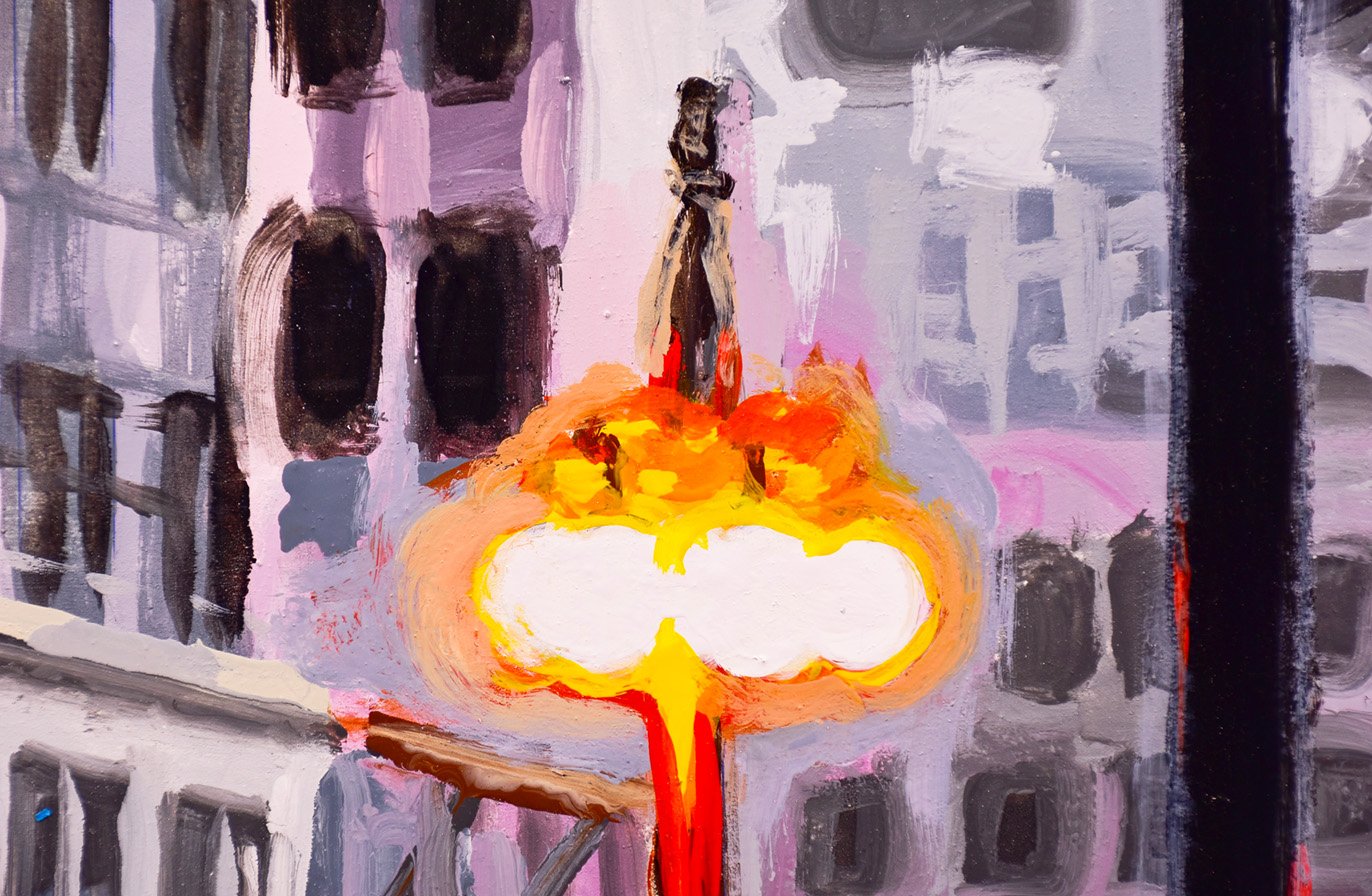
Unlike Hyperrealism, which erases the painter's trace until the surface is smooth, here matter is celebrated. The brushstroke is present, perceived as a physical vibration: there is volume, texture, rhythm. The gesture does not hinder the image, it enriches it. And it gives the painting an active presence that goes beyond what it represents.
That matter is also memory. A painting is not only what is seen on its surface, but everything beneath: the previous layers, the corrections that left their trace, the covered strokes that still breathe through what came after. The painting holds the history of its own process within its thickness. The viewer does not read it consciously, but perceives it as density, as the sense that what stands before them was lived before it was finished.
Working in layers
What looks in a painting like swift execution is often the fruit of a long process: observation, preliminary study, planned colour decisions, superimposed layers, deliberate corrections hidden beneath the final paint. That appearance of immediacy over a real elaboration is part of the style's code.
The layers and glazes grade the light without losing depth of colour. The light does not stay as an effect on the surface: it sinks into the matter and breathes from within. This is why a single area can look warm or cool depending on the angle, the hour, or the mood of the one who looks.
The first documented case: enamel on aluminium
Every artist finds the medium that best serves their gaze. The style imposes none. But it is worth showing a concrete case, because ideas are better understood embodied in a real practice.
The first documented body of work in this style — that of Sócrates Rízquez — uses synthetic enamel on aluminium. It is not the norm of Hyperimpressionism: it is one of its possibilities, the one a particular painter chose and developed.
Enamel has qualities that make it akin to this language. It dries quickly and does not allow colours to be blended on the surface, which forces a more conscious brushstroke: each stroke weighs more, each gesture counts, the risk of the irreversible heightens the execution. Its glossy finish and saturation make each area converse with the surrounding light. On aluminium, the surface ceases to be a passive support: it bounces, catches and reflects the light, so that the viewer's position changes how the painting responds. It is not a window onto a scene: it is an active luminous presence.
Any medium of industrial — or conventional — origin that shares that chromatic density and that capacity to reflect light can produce similar effects. What matters is not the enamel: it is that the surface takes part.
Genealogy
Every new style carries an uncomfortable question: was another name needed? Hyperimpressionism answers from within its own word.
Why this name
To name a style is not to put a label on it. It is to take a position. The term does not seek singularity, nor to fit into a genealogy: it names exactly what the style does — an intensification, hyper, of the emotional and luminous principles of impressionism.
The "hyper" does not mean excess. It does two things at once. On one hand, it is an expansion of the gaze: carrying perception beyond what the ordinary eye registers, without losing the poetic sensibility that Impressionism established. On the other, it is a deliberate nod to Hyperrealism, from which this style takes its technical rigour and its demand for precision. The prefix is, then, the hinge of the name: the point where the two inheritances meet. "Impressionism" provides the root — emotion, light, atmosphere; "hyper" provides at once its intensification and the echo of hyperrealist rigour. The name, read in full, already contains the programme of the style: the emotion of the one, carried further, with the demand of the other.
The term does not seek to break with what came before, but to carry it further. Neither negation nor mere evolution. It does not want to replace anything: it wants to add what was missing. To the technical, soul. To the emotional, precision. To immediacy, permanence.
Why claim a style of its own
To acknowledge an inheritance does not oblige one to remain subordinate to it. That is where emancipation begins. Hyperimpressionism assumes its debt to Impressionism — light, atmosphere, the vibration of the instant — and to Hyperrealism — technical rigour, respect for the visible — but neither of those inheritances can be inhabited today without transforming it.
This emancipation is not a hostile rupture nor a rejection of the past. It is serene and respectful. Only those who have understood where they come from can emancipate themselves. Tradition is not abandoned: it is transcended. One separates not to destroy, but to build in freedom.
And it does so by resolving a false opposition that has impoverished contemporary art for decades: the one that pits pictorial emotion against technical perfection, as if one had to choose. Hyperimpressionism refuses that choice. It brings both together, not as a middle ground, but as active synthesis.
It is born, moreover, in the studio, not in books. It is not a theory looking for works to illustrate it: it is a practice that asked to be named. That is why it claims a name of its own. Not as a gesture of vanity, but as an act of fidelity and of conquest: fidelity to the original pictorial emotion, and the conquest of a territory no earlier style had fully inhabited.
The first documented case
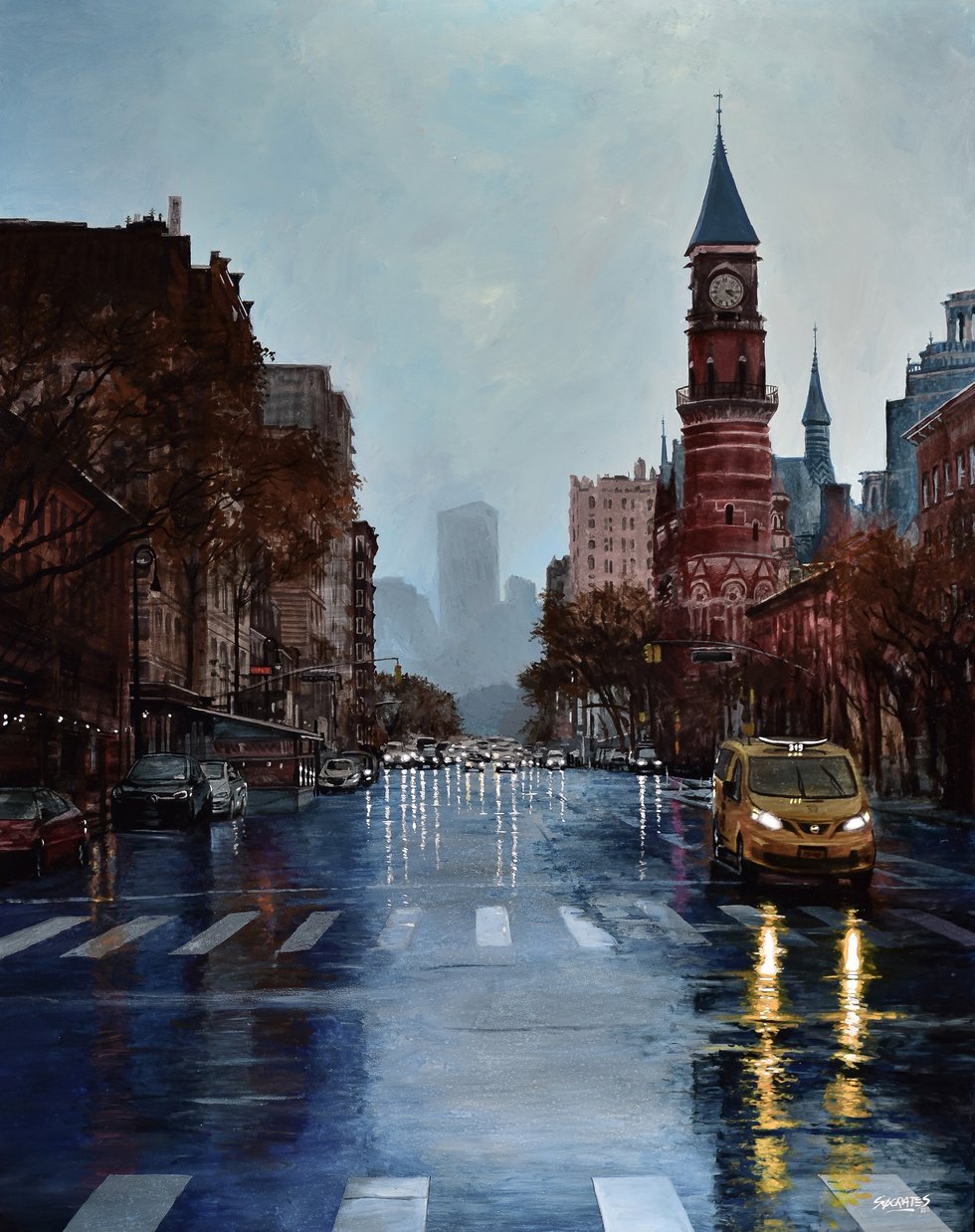
Every style has a point of origin. A first work, a first gaze that articulates it before it has a name. In the case of Hyperimpressionism, that origin is the work of Sócrates Rízquez.
Not because the style belongs to him — we have already said it cannot be owned — but because it was from his painting that it was first recognised, named and formulated. Hyperimpressionism was not born as a theory: it was born as a practice. It existed in a way of painting long before it had a manifesto to explain it.
A gaze before a method
Sócrates Rízquez did not arrive at Hyperimpressionism from books, but from the studio. For years he painted in search of something that did not quite fit any known style: there were affinities, echoes, recognisable influences, but no current contained it entirely. His painting was in dialogue with many worlds without identifying with any of them.
It was in recognising that aesthetic orphanhood — the need to name what he had long been building in silence — that the style found its word. The name was not invented to head a movement: it was discovered to give meaning to a body of work that already existed.
A way of being in painting
There is in this origin an ethics worth mentioning, because it is part of the style as much as its technique. A conscious refusal to understand painting as competition: no contests, no measuring up, no winning by elimination. Not out of contempt for those who choose that path — it is legitimate, and for many artists decisive — but out of a different conviction: that a work should not impose itself, but exist, breathe and find whoever is willing to look at it without a stopwatch or a score.
That attitude — painting without competing, without rushing, without asking permission — is consistent with a style that asks for time to be made and time to be looked at.
See the work
The body of work that gave rise to the style can be seen in its own space.
A clarification is in order: that space is where the work of Sócrates Rízquez is exhibited and, where applicable, acquired. It is a site distinct from this one. Here the movement is thought; there the work of its first author lives. Keeping them separate is deliberate: Hyperimpressionism is larger than any painter who practises it, including the first.
Closing
Hyperimpressionism is not a point of arrival. It is a point of departure.
It does not seek to enclose painting in a formula, nor to claim a territory for anyone. It proposes a way of looking — attentive, sustained, honest — and offers it to whoever wishes to recognise themselves in it. The rest, as it should be, will be said by the paintings.